
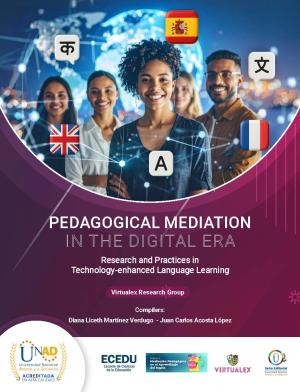
Mediación pedagógica en la era digital
Investigación y prácticas en el aprendizaje de idiomas potenciado por la tecnología
- Fecha de recepción oficial de la propuesta: 2024-09-23
- Fecha decisión editorial: 2024-10-10
- Tipo de revisión por pares: Doble - ciego
La editorial declara haber utilizado algún sistema de búsqueda de plagio.
Autores: Marcela Díaz Ramírez, Linda Luz Lee, Paola Julie Aguilar Cruz, Edgar Picón Jácome, Lina Marcela Alfonso Bermúdez, Diana Angélica Parra Pérez, Olga Shugurova, Nélida Cárdenas Vergaño, María Cristina Otálora, Marlon Vanegas Rojas, Edwin Omar Toscano Pretelt, Diego Humberto Olarte Roa, Juan Camilo Pérez Hernández, Edwin Andres Londoño Alape, Diana Liceth Martínez Verdugo, Martha Isabel Díaz Ramírez, Leidy Viviana Pérez Cárdenas, Diego David Barragán Ferro

In the past decade, digital technology has transformed the landscape of education, particularly in language learning. From artificial intelligence to gamified learning environments and big data, these tools have unlocked new possibilities to engage students, fostering creativity and promoting self-directed learning.
However, the successful integration of these technologies hinges on the role of teachers and their ability to mediate and guide the learning process, ensuring that digital tools are used effectively and purposefully. This relationship between technological innovation and pedagogical mediation serves as the cornerstone of this book, as it aims to explore how language educators can harness the potential of digital tools, keeping a strong focus on meaningful learning outcomes.
Most of the research presented in this book is based on the latest research presented at the 3rd International Congress on Pedagogical Mediation in Language Learning, an academic event organized by the Master´s Program in Pedagogical Mediation in English Learning at UNAD. This congress brought together researchers, educators, and practitioners to explore the intersection of pedagogical mediation and technology. The congress served as a platform to discuss how innovations in digital technology can transform language teaching and learning, highlighting the critical role of pedagogical strategies in ensuring that technology fosters innovative educational progress. This book, therefore, offers a comprehensive collection of studies and practical insights that reflect current research and future directions in this rapidly evolving field.
Palabras Clave:
Tecnología digitalEducaciónAprendizaje de idiomasInteligencia artificialGamificaciónEducación secundariaEnseñanza tecnológicaCategorías:
- EDU041000. EDUCACIÓN > Educación a distancia, abierta y en línea
- YPMT. Enseñanza: tecnología
- 371.3. Sociología y Antropología > Educación > Gestión escolar; educación especial > Métodos de instrucción y estudio
Leidy Viviana Pérez Cárdenas.
Is a Doctoral student in “Innovación Educativa y Cultura Digital” at Universidad de Cartagena. Master of Pedagogical Mediation in Learning English. She holds a Specialization in Education Management and a Bachelor’s degree in Teaching English as a Foreign Language from the UPTC and a TESOL certificate from Perimeter College in the USA. She currently works as a full-time professor at UPTC. As an active researcher, she is the leader of IMCLE and a member of the SIMILES research group. Her main research addresses ELT methodological strategies, perceptions, and emotions of young students in foreign language acquisition, educational gamification, global digital citizenship, pedagogical mediation in English language teaching, and the development of virtual learning environments, contributing significantly to the field of applied linguistics and digital pedagogy.
- Disruptive Innovation in EducationFrom ICT Tools to LKT and EPT Environments
- Digital Educational Resources in the Writing and Communication Centers
- Harnessing Artificial Intelligence for English Language Learning in the Post-Pandemic EraA Systematic Literature Review
- The Influence of Students´ Technology Appropriation on Their Digital Literacy Development in an EFL Class
- Didactic Sequence Model for the Design of Gamified Digital Educational Resources to Improve English Oral Communication Skills
- Self-Authorship Mediated by a Visual Dialogue with AIA Student’s Story of Mental Wellbeing in Experiential Learning
- Systematization of an Assessment for Learning (AfL) Experience in a Virtual English Course
- Connecting Classrooms GloballyThe Impact of COIL on Colombian High School Students
- Teaching English as a Foreign Language in Higher Education. Professor’s DevelopmentA Case Study on Theoretical Foundations, Metacognitive Processes, and Digital Culture Integration
- ID: SIMEHEBOOK5I0GDAIC47EFF80E8G78
- Año de Publicación: 2025
- Presentación: PDF (Digital: descarga y online)
- Número absoluto de páginas: 230 Páginas
- ISBN13: 9786287786356
- DOI: https://doi.org/10.22490/UNAD.9786287786356