
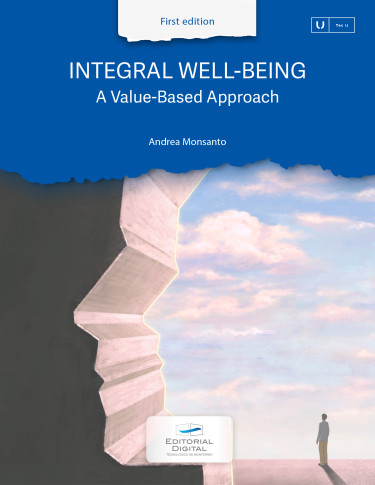
Integral Well-being. A Value-Based Approach

- Fecha de recepción oficial de la propuesta: 2022-12-07
- Fecha decisión editorial: 2023-03-03
- Tipo de revisión por pares: Doble - ciego
La editorial declara haber utilizado algún sistema de búsqueda de plagio.
Autor: Andrea Monsanto

Emotional wellness is a concern that affects people worldwide. It's a situation that demands attention and action. However, addressing this issue can be challenging, given the complexity of human beings. But starting somewhere is essential to reduce suffering and enhance subjective well-being. This book offers practical guidance on how to improve our relationship with the crucial aspects of perception: time, space, and energy. Doing so provides a formula for improving all areas of life simultaneously.
Palabras Clave:
Well-beingCategorías:
- PSY003000. PSICOLOGÍA > Psicología Aplicada
- JM. Psicología
- 158. Filosofía y psicología > Psicología > Psicología Aplicada
List of figures
About the Author
Introduction
Part I. Self-Concept
Chapter 1. Constructing Self-Concept
1.1The Power of Words
1.2 Who Am I?
1.3 Social Aspects of Self-Concept
1.4 Wave or Particle?
1.5 The Changing Self
1.6 Good or Bad?
1.7 Summary
1.8 Put It into Practice!
Chapter 2. Relating to Time
2.1 Present, Past, and Future
2.2 Changing the Past: Dealing with Failure
2.3 Summary
2.4 Put It into Practice!
Chapter 3. Relating to Energy
3.1 Physical Energy
3.2 Emotional Energy
3.2.1 Emotional Valence
3.2.2 Feeling Pleasant Emotions
3.2.3 Processing Unpleasant Emotions
3.3 Mental Energy
3.3.1 Living a Conscious Life
3.3.2 Learning to Concentrate
3.3.3 Becoming Aware of Words and Stories
3.3.4 Recognizing Mental Distortions
3.4 Spiritual Energy
3.4.1 Connecting with Self
3.4.2 Connecting with Others
3.4.3 Connecting with Nature
3.4.4 Purpose in Life
3.5 Summary
3.6 Put It into Practice!
Chapter 4. Relating to Space
4.1 Outdoors
4.2 Indoors
4.3 Personal Space
4.4 Summary
4.5 Put It into Practice!
Part II. Values-Based Integral Well-being
Chapter 5. Values are Valuable
5.1 Values Theory
5.2 Types of Values
5.3 Values and Adaptation
5.4 Summary
5.5 Put It into Practice!
Chapter 6. Integral Well-being
6.1 Spiritual Dimension
6.2 Emotional Dimension
6.3 Social Dimension
6.3.1 Social Integration
6.3.2 Social Acceptance
6.3.3 Social Contribution
6.3.4 Social Actualization
6.3.5 Social Cohesion
6.4 Physical Dimension
6.4.1 Breathing
6.4.2 Nutrition
6.4.3 Why?
6.4.4 What?
6.4.5 How?
6.4.6 When?
6.4.7 How Much?
6.4.8 Sleep
6.4.9 Exercise
6.5 Intellectual Dimension
6.5.1 Wisdom
6.5.2 Right Thinking
6.5.3 Present Moment Awareness
6.5.4 Interoceptive Awareness
6.5.5 Intelligence
6.5.6 Problem Solving
6.5.7 Lifelong Learning
6.5.8 Exploring Intelligence
6.6 Occupational Dimension
6.7 Work Orientation
6.8 Productivity
6.8.1 Recharging and Renewing Energy to Avoid Depletion
6.8.2 Developing Good Organizational Skills
6.8.3 Developing Good Habits
6.9 Financial Dimension
6.10 Income
6.11 Expenses
6.12 Saving
6.13 Sharing
6.14 Summary
Chapter 7. My Values and I
7.1 Appreciative Inquiry (AI)
7.2 Discover
7.2.1 Self-diagnosis
7.3 Dream
7.3.1 Imagine the Future
7.4 Design
7.4.1 Determine a Value and Describe It
7.4.2 "SMART" Goals per Value
7.5 Deliver
7.5.1 Daily Checklist
7.5.2 Weekly Monitoring
7.5.3 Acceptance and Commitment Therapy (ACT) Matrix
7.6 Pyramid of Values
7.7 Vision Board
Conclusion
References
- ID: SIMEHEBOOKHAAFA9A3CJ595D6D1C55
- Año de Publicación: 2024
- Presentación: PDF (Digital: descarga y online)
- Número de páginas del contenido principal: 189 Páginas
- ISBN13: 9786075018478
- DOI: https://doi.org/doi.org/10.60514/4p0e-g384
- PVP: MXN 0.00