
Advancing Towards Gender Equality in Academia and Scientific Research, a Perspective from Higher Education Institutions

- Fecha de recepción oficial de la propuesta: 2024-03-12
- Fecha decisión editorial: 2024-07-23
- Tipo de revisión por pares: Doble - ciego
La editorial declara haber utilizado algún sistema de búsqueda de plagio.
Autores: Marta Ochman, Gerhard Niedrist, Miluska Orbegoso Silva
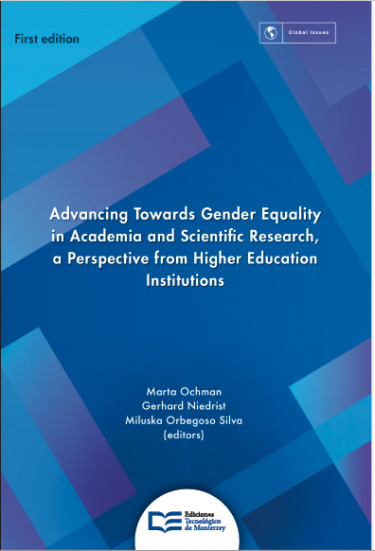
Advancing towards Gender Equality in Academia and Scientific Research, a perspective from Higher Education Institutions offers a diagnosis of gender inequality, a scholarly reflection on the structural barriers women face in developing a successful academic career, and an evaluation of the effectiveness of policies to address gender inequality in higher education. This book presents case studies from Mexico, Poland, Israel, China, and Japan.
Palabras Clave:
GéneroGenderStudiesCategorías:
- EDU001030. EDUCACIÓN > Administración > Mayor
- JNK. Organización y gestión educativa
- JNM. Educación superior y continua, educación terciaria
- 378. Sociología y Antropología > Educación > Educación más alta
About the authors
Introduction
Chapter 1. Gender equity policies in HEIs: what we learned from past experiences
1.1 Introduction
1.2 The myth of excellence and merit
1.3 The managerial model and its challenges for gender equality
1.4 Conclusions
Chapter 2. Confucianism, Science and Gender: An exploratory study of Fudan University
2.1 Introduction: Women, Science and Confucianism
2.2 Confucianism, Learning, and Woman
2.3 Fudan University
2.4 Perceptions about the role of Confucianism in the scientific promotion of the women
2.5 Conclusions
Chapter 3. Japanese Women in Academia: A Dichotomy between Progress and a Traditional Society
3.1 Introduction
3.2 Historical perspective
3.3 The case of U Tokyo
3.4 Conclusions
Chapter 4. A quantitative approach to women professors’ barriers in their research careers in Mexico. The case of Tecnológico de Monterrey
4.1 Introduction
4.2 Women Professors’ Barriers
4.3 The National System of Researchers (SNII)
4.4 The SNII within the Tecnológico de Monterrey
4.5 Women are less likely to advance in the SNII
4.6 Results
4.7 Conclusions
Chapter 5. A Grand Gender Convergence in the Startup Nation? Gender quality in Israeli Academia and Scientific Research
5.1 Introduction
5.2 The Israeli Startup Ecosystem
5.3 Closing the Gender Gap: Life-cycle Approaches
5.4 Gender Convergence? The Quest for Labor Market Flexibility
5.5 Conclusions
Chapter 6. Gender Equality Plan: Lessons from the University of Warsaw
6.1 Introduction
6.2 Contextualization of the case
6.3 Methodology of the study
6.4 GEP through the experience of its authors
6.5 Conclusions
Chapter 7. Beyond Metrics and Data: Gender Reflections and Challenges in Assessing Faculty Impact at Tecnológico de Monterrey
7.1 Introduction
7.2 Literature Review
7.3 Research at Tecnológico de Monterrey
7.4 The Impact Tool
7.5 Risks of gender bias and gaps in the Impact Tool
7.6 Conclusions
Final reflection
- ID: SIMEHPRINT503B1D1G17FD4G3B81I5
- Año de Publicación: 2025
- Presentación: Trade paperback (EE.UU) (Tapa blanda o Bolsillo)
- Tamaño: 228.6 x 152.4 x 1.2 cm
- Número de páginas del contenido principal: 206 Páginas
- ISBN13: 9786075018720
- Peso: 0.341 kg
- PVP: MXN 300
- ID: SIMEHEBOOK67B4JF5G3FE7I96J876B
- Año de Publicación: 2025
- Presentación: EPUB (Digital: descarga y online)
- Número de páginas del contenido principal: 206 Páginas
- ISBN13: 9786075018744
- DOI: https://doi.org/doi.org/10.60514/mhbq-vz12
- PVP: MXN 240.00
- ID: SIMEHPOD8IC78333A2B83II57B18
- Año de Publicación: 2025
- Presentación: Trade paperback (EE.UU) (Libro)
- Número de páginas del contenido principal: 206 Páginas
- ISBN13: 9786075018720
- PVP: ARS 64225.7
- PVP: MXN 300
- PVP: COP 69223